Abstract —We study how learned systems come to represent, reason, and
cooperate — and we publish everything we find.1
Synthesis is a small laboratory with a simple wager: that understanding intelligence is
first a problem of seeing it clearly.
Figure 1. Curl-noise flow field, n = 4,200 particles, ink on paper. Drawn live in your browser.seed 0x000000
§1
Research areas
Three programs, one question: what is a model actually doing?
Each area is run like a long paper — a thesis, a method, and the discipline to say when we are wrong.2
AREA 01 / INT1,284 citations
Interpretability
Abstract.We reverse-engineer trained networks into circuits with human-legible function. Current work traces how sparse features compose across layers, and why those circuits survive — or quietly fail — when the data distribution moves under them. The goal is a microscope, not a metaphor.
Abstract.Populations of simple learners produce structure none of them contains — conventions, markets, division of labour. We build minimal multi-agent worlds where emergence can be measured rather than admired, and ask which collective behaviours are predictable before they appear.
Abstract.A model that cannot show its uncertainty is a confident stranger. We design interfaces where machine reasoning is inspectable in place — attention you can touch, confidence you can read at a glance, and corrections that flow back into the model.
Below, a single attention head from our open 12-layer model reads a sentence about itself.
Blue intensity is attention weight. Hover any cell to read the pair; the wave you see is the head settling during inference.3
hover or tap a cell — attn(query, key) will appear here
Synthesis is deliberately small. Fourteen people, one building, no product roadmap.
We are funded by an endowment structured to be indifferent to hype cycles,5
which buys the only thing a laboratory really needs: the right to work on questions that take years.
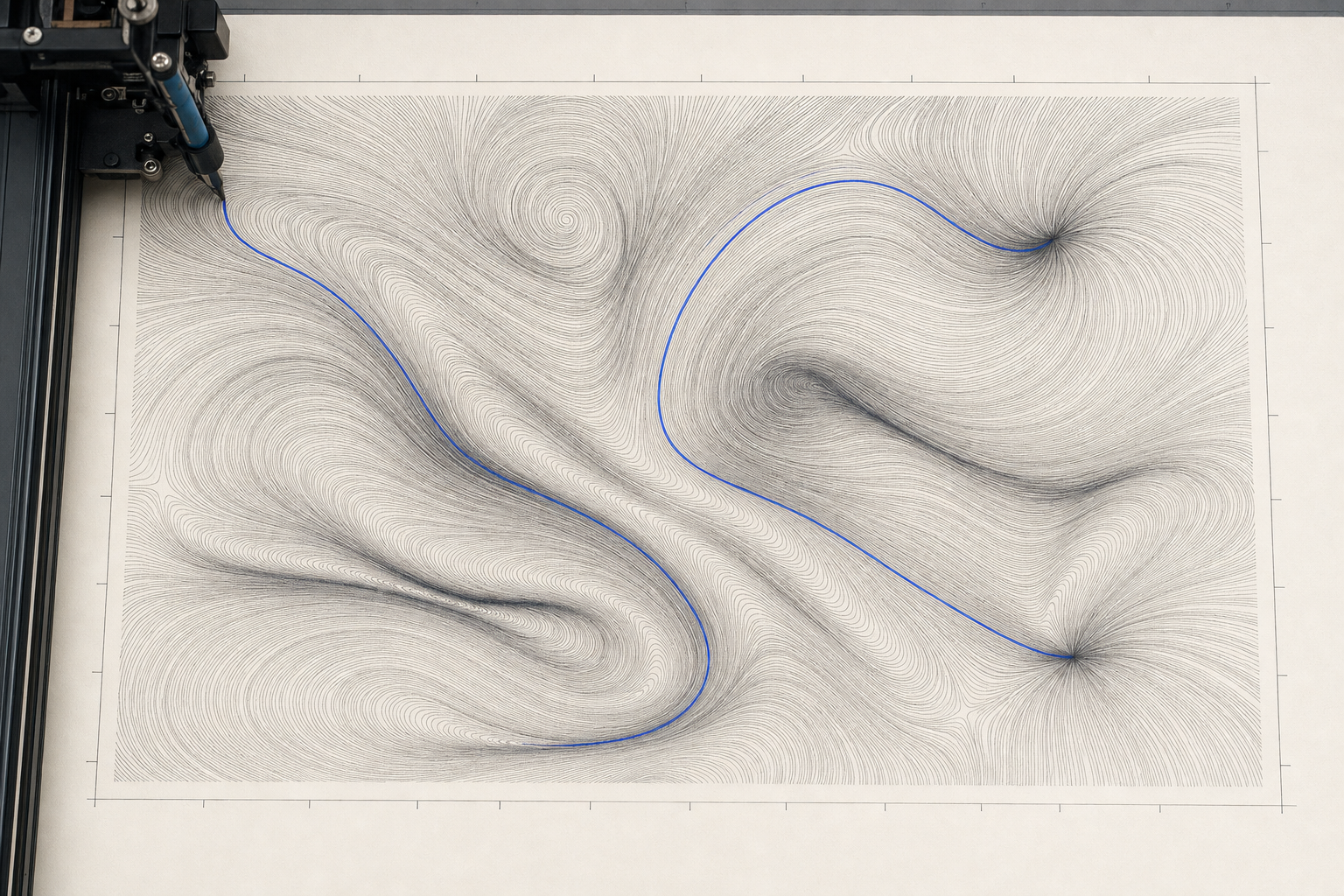
Our house style is the figure, not the demo. If a result cannot be drawn — as a circuit,
a phase diagram, a field — we assume we do not understand it yet. The plotter in the lobby
(Fig. 3) draws one vector field from our models every morning; the archive holds 612 of them,
one per working day since we opened.
23papers published
14researchers & staff
100%open access
Figure 3. Morning field №612, pen plotter, ink on archival paper. Lobby archive.2026-07-09
§5
People
Six researchers, listed the way we cite them. No headshots — read the work.
Dr. Mara Voss
Director · Interpretability
Traces circuits the way her grandfather traced watch movements: assume every part has a job, then prove it.
prev: DeepMind · ETH Zürich
Jun Park
Senior Researcher · Interpretability
Wrote the lab's feature-geometry toolkit. Believes most disagreements about models are disagreements about bases.
prev: Seoul National · Anthropic
Amelia Ostrowski
Senior Researcher · Emergent Systems
Runs the 10,000-agent economies. Keeps a phase diagram of every failed run taped above her desk, labelled "the map".
prev: Santa Fe Institute
Theo Lindqvist
Researcher · Theory
Works at the whiteboard until noon, at the cluster after. The amortized-search framing of attention is his.
prev: KTH · MIT CSAIL
Priya Raghunathan
Researcher · Human–AI Interfaces
Field-tests interfaces in hospitals and control rooms. Insists every uncertainty display be legible from two metres.
prev: IIT Madras · CMU HCII
Sam Adeyemi
Researcher · Measurement
Owns the probes, the benchmarks, and the lab's healthy paranoia about both. Author of the probe scaling laws.
prev: Univ. of Lagos · Oxford
§6
Open questions
The footnotes we haven't earned yet. If one of these keeps you up at night, write to us.
†1
Is there a natural basis for what a network knows — or only bases we find convenient?
Sparse features look canonical until the distribution moves. We suspect "the" features of a model are a property of model × data × probe, and we would love to be wrong.
†2
Can emergence be forecast the way we forecast weather — badly, but usefully?
We can predict one phase transition in one toy economy. The gap between that and "this capability will appear at this scale" is the largest open gap we know of.
†3
What is the unit of explanation — the circuit, the feature, or the story?
Human-legible explanations compress. Every compression discards. Which discards are safe is an empirical question nobody has operationalized well, including us.
†4
Can an interface make a model honest, or only make its dishonesty legible?
Calibrated displays change what people do with model outputs. Whether they change what models are optimized to output is a question about training, not pixels.
†5
What would a result have to look like for this lab to say "stop"?
We maintain a written answer and revise it yearly. Publishing it is an open question of a different kind.